

Table of Contents
Toggle10 Best Agentic CRM Platforms for Roofing Companies in 2026
Running a roofing company in 2026 is far more complex than it was even five years ago. Between managing leads, inspections, job sites, materials, estimates, insurance paperwork, team schedules, and customer communication—it’s easy for things to slip through the cracks.
A missed follow‑up can cost you a $15,000 roof replacement. A delayed estimate can lose you a commercial contract. Manual workflows slow growth.
That’s where agentic roofing CRMs come in.
In this comprehensive guide, you’ll learn:
- What a roofing‑specific CRM actually does
- Why roofing companies urgently need automation & AI today
- Must‑have features every modern roofing CRM should offer
- The 10 best roofing CRMs in 2026, ranked with explanations
- How to choose the right CRM based on your company’s size
This guide is built for owners, managers, and decision‑makers who want to scale smarter, reduce chaos, and increase revenue.
What is a CRM for Roofing Local Business?
A CRM (Customer Relationship Management system) for roofing companies is a centralized platform that stores your customer data, manages leads, tracks jobs, automates follow‑ups, organizes field operations, handles invoicing, and helps your team stay aligned.
Unlike general CRMs, roofing CRMs include tools specifically for:
- Aerial measurements
- Roofing estimates & material lists
- Job pipeline tracking
- Crew scheduling
- Invoicing & financing
- Before/after photos
- Field updates
The average roofing company sees a 34–45% increase in productivity after switching from spreadsheets to a unified CRM system.
Why Your Roofing Business Needs an Agentic CRM in 2026
Roofing companies today face:
- More competition in local markets
- Higher customer expectations
- Shorter lead response windows
- Rapidly shifting project schedules
- Labor shortages
A modern CRM solves these problems by providing:
- Automated lead follow-ups: AI ensures no lead goes cold.
- Real-time job visibility: Track every job from inspection → estimate → production → invoice.
- Crew and subcontractor coordination: Assign jobs, send updates, and monitor work onsite.
- Instant digital estimates: Roofers who send estimates within 24 hours close 67% more deals.
- Financial tracking and faster payments: Track invoices, financing options, and outstanding payments in one place.
- AI forecasting and workload predictions: Helps you avoid overbooking crews or underusing resources.
How Roofing CRMs Streamline Sales, Jobs & Communication
Roofing CRMs provide end‑to‑end clarity:
- All leads live in one dashboard
- Automated reminders prevent missed appointments
- Sales reps, project managers, crews, and homeowners stay aligned
- Change orders, photos, and files sync instantly
- Customers receive automated updates
- Teams collaborate in real time, reducing rework
Businesses using CRMs generally experience:
📈 29% increase in sales
📉 23% reduction in operational mistakes
⚡ 34% boost in productivity
Take the Next Step Toward a Smarter Roofing Operation
Get the clarity, automation, and control your roofing business needs to scale without the chaos.
- Streamline leads, jobs, invoicing, and field updates in one unified system
- Reduce admin work with AI-powered workflows and real-time visibility
- Equip your team with tools built for roofing crews, managers, and office staff
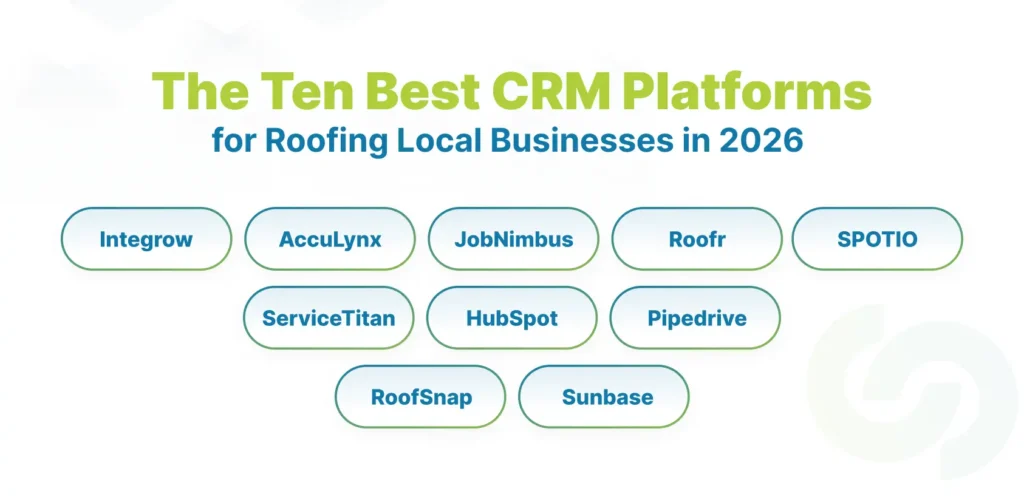
The 10 Best Agentic CRM Platforms for Roofing Companies in 2026
Here is an improved, detailed breakdown of each platform:
1. Integrow (Best All‑in‑One Roofing CRM + ERP + Agentic AI)
Best for: Growing, multi‑location, and commercial roofing companies
Integrow is the only truly unified agentic CRM + ERP built for contractors. It includes:
- Lead & job management
- AI‑powered workflows
- Aerial measurement integrations
- Project scheduling
- Asset management
- HR & timesheets
- Marketing automation
- Financial tracking
- Expert onboarding support
This platform is ideal if you want one dashboard for the entire business instead of using 5–7 disconnected tools.
Integrow uses a custom-quote pricing model tailored to company size, modules, and automation needs.
2. AccuLynx
Great for workflow automation, job tracking, and roofing paperwork. Known for strong integrations with aerial measurement tools. For checking the price you have to contact them.
3. JobNimbus
Strong in project management, estimating, automation, and field tools. Popular among small and mid‑sized roofing companies.
JobNimbus pricing varies by plan. Verified sources show:
- Starting price: $300 per month (CRM base pricing).
- Detailed plans: “Request pricing” for Growing & Established tiers.
4. Roofr
Very user-friendly. Great for quick estimates, proposals, and basic job tracking. Good for residential roofing teams.
Roofr’s pricing is 100% publicly available:
- Pay-As-You-Go: Free plan
- Pro Plan: $99/month USD
- Premium Plan: $169/month USD
- Elite: Contact Sales for custom pricing
5. SPOTIO
- Starter: $25/user/month
- Growth: $50/user/month
- Enterprise: $100/user/month
(For 10 users: $250–$1,000 monthly)
6. ServiceTitan
A robust field service management system with deep reporting, scheduling, and invoicing capabilities. Great for large companies.
ServiceTitan has the widest cost range:
- Typical cost: $250–$500 per technician per month
7. HubSpot for Roofing
Best for companies focused on marketing automation. More customizable than most CRMs.
HubSpot is the only CRM with a forever-free plan.
From verified sources:
- Free CRM: $0/month
- Starter plans:
- Marketing Hub: from $20/month
- Sales Hub: from $20/month
- Service Hub: from $20/month
8. Pipedrive
- Lite: $14/month per user
- Growth: $39/month per user
- Premium: $59/month per user
- Ultimate: $79/month per user
9. RoofSnap
Great for aerial measurements, digital estimates, and roofing-specific workflows.
RoofSnap offers subscription + pay-per-report pricing:
- Pay-As-You-Go: $13 per measurement report
- Monthly Subscription: Starting at $105/user/month
- Annual Subscription: As low as $52/user/month (team-size dependent)
10. Sunbase
Includes lead tracking, project milestones, field coordination, and simple communication tools.
Sunbase does not publish pricing.
- Verified: “Starting price: Contact vendor for pricing.”
Must-Have Features in a Modern Roofing CRM (2026 Edition)
These are must‑have, non‑negotiable functionalities for a roofing company:
1. Lead Management & Canvassing Tools
Capture, track, and manage leads from:
- Website
- Phone calls
- Facebook ads
- Storm campaigns
- Referrals
- Door knocking apps
AI‑powered workflows ensure instant follow‑ups.
2. Job Pipeline & Project Tracking
A complete dashboard showing every job stage:
- New lead
- Inspection
- Estimate sent
- Approved
- Material ordered
- In progress
- Completed
- Paid
This reduces bottlenecks and keeps your team aligned.
3. Digital Measurements & Fast Estimating
Look for:
- Aerial measurements
- Blueprint uploads
- Auto‑generated estimates
- Custom material lists
Speed = higher close rates.
4. Invoicing, Payments & Financing
Send invoices in seconds, track payments, and offer financing options to close more deals.
5. Reporting & Analytics
Track key roofing metrics:
- Lead conversion
- Job profitability
- Sales team performance
- Marketing ROI
- Cash flow
6. Integrations
Your CRM should connect to:
- QuickBooks
- EagleView / Hover
- Google Calendar
- Scheduling tools
- Material suppliers
- Email & SMS platforms
7. Mobile App & Field Tools
Crews need:
- Job updates
- Access to photos
- Estimate approvals
- GPS check‑ins
- Onsite document uploads
8. AI Automation & Agentic Workflows
This is what separates 2026 CRMs from older platforms:
- Auto‑generate follow-up sequences
- Predict material needs
- Forecast workload
- Auto‑assign leads to reps
- Create proposals instantly
How to Choose the Right CRM for Your Roofing Business
For Small Roofing Teams (1–5 people)
Choose:
- Pipedrive
- RoofSnap
- HubSpot Starter
- Roofr
Simple setup, low cost, easy to use.
For Growing Roofing Companies
Choose:
- Integrow
- JobNimbus
- Roofr
- SPOTIO
You need stronger job tracking + automation + payments.
For Large or Multi‑Location Companies
Choose:
- Integrow
- AccuLynx
- ServiceTitan
Scalability, integrations, ERP‑level controls.
For Commercial Roofing Contractors
Choose:
- Integrow
- ServiceTitan
You need subcontractor management, compliance tools, and powerful reporting.
Frequently Asked Questions
What is the best CRM for roofing companies?
- For all‑in‑one operations: Integrow
- For simple workflows: Roofr or Pipedrive
- For advanced job tracking: AccuLynx or JobNimbus
Which CRM integrates with QuickBooks?
- Integrow
- JobNimbus
- AccuLynx
- Roofr
- ServiceTitan
Is there a free roofing CRM?
Not fully. Some offer free trials or limited plans (like HubSpot), but roofing-specific CRMs are usually paid.
Which CRM is best for commercial roofing?
Integrow and ServiceTitan due to advanced project scalability and financial controls.
Ready to Transform Your Roofing Business?
Move away from manual processes and step into a streamlined, automated, and growth-ready system.

Farhan Ali
Farhan Ali is an SEO and Content Strategist at Cloud Consulting Inc, with over 6 years of experience specialized in the ERP and CRM services niche. He bridges the gap between complex enterprise technology and high-ranking search visibility, transforming technical software capabilities into authoritative, conversion-driven content.
Drowning in Manual Data Entry & Fragmented Workflows?
Automate your growth engine with intelligent, end-to-end data integration.
Grow FasterAbout Integrow
Integrow is an AI-powered CRM and ERP platform that unifies fragmented business operations into one intelligent system. We automate complex workflows and document processing to help teams integrate, validate, and scale with total precision.
Grow FasterDrowning in Manual Data Entry & Fragmented Workflows?
Automate your growth engine with intelligent, end-to-end data integration.
Grow Faster