

Table of Contents
ToggleHR’s 8-System Nightmare: Why Onboarding Feels Broken (and How to Fix It)
Somewhere right now, a Day 5 new hire still doesn’t have their laptop.
Their name is in the HRIS, but not in IT’s provisioning tool.
Their org chart listing is outdated.
Their welcome email is stuck in someone’s drafts.
It’s not that HR is out on a permanent vacation; it’s completely the opposite. They’re buried in “The Stack of Sadness”—an overwhelming cluster of 8 disconnected systems, each one managing a different part of the employee lifecycle.
The Stack of Sadness: HR’s Real-Life Tech Tangle
The Stack of Sadness looks something like this:
- One system for recruitment
- Another for background checks
- A third for onboarding
- A fourth for benefits
- A fifth for time tracking
- A sixth for payroll
- A seventh for IT provisioning
- And an eighth for reporting/org charts
And that’s on a good day.
Each of these systems requires manual handoffs. Each introduces friction, delays, and data loss. And in the middle of it all, HR is copying and pasting, nudging stakeholders, tracking down missing updates, and stitching together a fragmented view of each employee.
The Human Cost of System Sprawl
This drags on every part of the employee experience and minimizes HR’s impact.
Now, onboarding takes 40% longer than it should, which isn’t conducive to a superb first impression. Instead of stepping into a well-communicated first day, new hires are immediately thrown into a mess of disorganization and impersonal, time-consuming processes to get what they need.
They can’t go to HR because HR is spending up to 60% of their time on data entry and workarounds. So, they either suffer or leave, which can get expensive.
Real Numbers from a Real Company
One 75-person company recently mapped the cost of its disjointed HR systems. They discovered that:
- 312 hours/month were being spent on manual admin
- $125,000/year was wrapped up in hidden operational costs
- It took an average of 5 days to provision a new hire fully
A minimum of 8 separate systems were being used across the employee lifecycle
What Unified HR Operations Looks Like
Why live in that reality? Why introduce new hires to such a mess when unification is simple, smooth, and doable, with benefits like:
- One system that handles hire-to-retire
- IT provisioning that happens automatically when someone’s hired
- Org charts that update in real time
- Compliance, audits, and approvals that are built in
Now, instead of doing routine, manual tasks, HR lives up to the title of Human Resources, new hires have what they need to be successful, and you’re not paying for a never-ending revolving door of employees.
A View of Transformation in Application
This isn’t a two-year roadmap. Here’s what one company achieved in under 90 days:
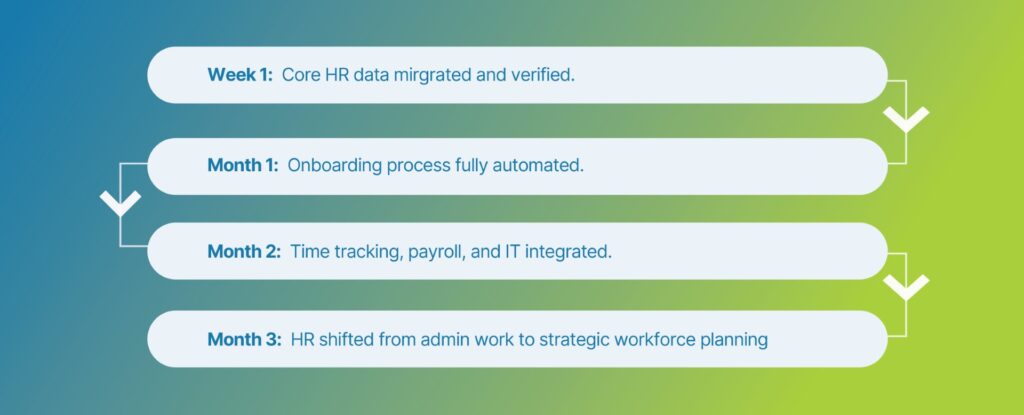
By consolidating tools into one unified system, they unlocked the bandwidth to focus on people, and that’s made all the difference.
It’s Time to Break the Stack
If reading this feels all too familiar, you’re not alone. Many HR teams are buried in spreadsheets, hand-offs, and scattered systems rather than focusing on people.
Our 90-Day Playbook gives you the step-by-step roadmap to move from chaos to control — with one unified system, one source of truth, and one platform that works the way your teams need it to.
Download the free playbook now and get the checklist, implementation plan, and framework you need to start seeing change in 90 days.
Or… if you’d rather skip the reading and see what unification could look like for your organization, book a 15 minute meeting with our team – we’ll walk you through how Integrow can simplify your HR stack and get your people up and running faster.

Farhan Ali
Farhan Ali is an SEO and Content Strategist at Cloud Consulting Inc, with over 6 years of experience specialized in the ERP and CRM services niche. He bridges the gap between complex enterprise technology and high-ranking search visibility, transforming technical software capabilities into authoritative, conversion-driven content.
Drowning in Manual Data Entry & Fragmented Workflows?
Automate your growth engine with intelligent, end-to-end data integration.
Grow FasterAbout Integrow
Integrow is an AI-powered CRM and ERP platform that unifies fragmented business operations into one intelligent system. We automate complex workflows and document processing to help teams integrate, validate, and scale with total precision.
Grow FasterDrowning in Manual Data Entry & Fragmented Workflows?
Automate your growth engine with intelligent, end-to-end data integration.
Grow Faster